
When the Mind Mistakes Social Media for Reality
Saji Gopalan
August 24, 2026
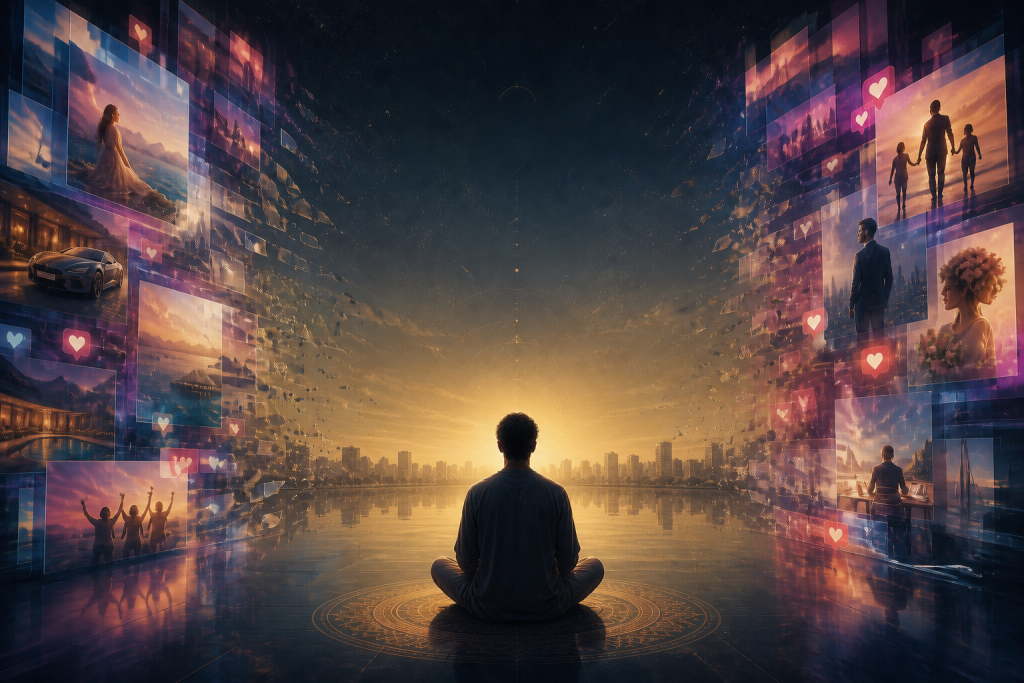

We have never had more ways to see the world. Yet social media may be making it harder to see clearly.
Millions of Americans scroll through images of beautiful people, successful careers, happy families, luxurious homes, and effortless lives. Advertisements tell us what to want. Algorithms learn what captures our attention and show us more.
None of this has to be fake.
The problem is what happens when a fragment begins to feel like the whole.
A photograph captures a moment. A short video captures seconds. A profile displays selected moments. Our minds instinctively fill in what we cannot see. We may assume the attractive person is confident, the wealthy person is fulfilled, the successful person is happy, and the perfect family is actually perfect.
Then comes the thought:
If I had what they have, I would be happy.
The thought is ancient. The technology amplifying it is new.
For thousands of years, Indian philosophical traditions have examined the difference between reality and the way it appears to the mind. Vedanta uses the concept of Maya (illusion) to describe how reality can be experienced through appearances, names, forms, and mental interpretations.
Maya is often translated as “illusion,” but that can be misleading. The idea is not that everything we see is unreal. Rather, we can mistake an appearance—or our interpretation of it—for the whole truth.
That distinction is relevant to social media.
The ancient text Rig Veda (Purusha Suktam) describes the visibly manifested universe as only a portion of the greater cosmic reality. The Upanishadic tradition directs attention beyond sensory appearances toward what lies beneath. Another text, Dakshinamurti Stotram (by Adi Shankaracharya), offers a striking metaphor: the world is compared with a city appearing in a mirror. What we experience is not simply the world “out there,” but the world as perceived by our mind.
Modern neuroscience approaches perception differently, yet raises a related question: How directly do we actually experience the world? Seeing is not a simple process of a camera-like brain recording the external world. Light reaches the eyes, neural signals are processed through multiple stages, and the brain integrates sensory information with prior experience and expectations to construct conscious visual experience. There is, in other words, a gap between the world and our experience of it.
Social media adds another layer of interpretation.
Before an image reaches us, someone selected the moment, chose the frame, adjusted the lighting, wrote the caption, and decided what not to show. Algorithms then determine whether we see it again.
The result is distortion. We compare the unedited complexity of our own lives with the edited presentation of someone else’s.
We compare our Tuesday with somebody else’s vacation.
Our body with somebody else’s best photograph.
Our career with somebody else’s announcement.
Our family with somebody else’s chosen moment.
And gradually, the projection becomes our reference point for reality.
This is where an ancient Vedantic practice becomes practical: Viveka, or discernment.
Discernment asks us to distinguish between what is actually present and what the mind adds to it.
A photograph may be beautiful without telling us whether its subject is happy. A successful career may bring satisfaction without guaranteeing fulfillment. A material possession may bring pleasure without providing lasting contentment.
The lesson is not that social media is bad, nor that ambition, beauty, wealth, or success are meaningless.
The lesson is simpler: do not confuse an appearance with the entirety of reality.
This matters beyond individual happiness. When millions of people consume carefully constructed images every day, those images can shape collective ideas about what a successful life should look like. They influence what we desire, what we compare ourselves against, and what we lack.
The technology is new. The human tendency is not.
Earlier generations asked: What is real? What merely appears to be real? Who is the one experiencing it?
We are asking the same questions while holding smartphones.
The answer is not to abandon the digital world but to become more discerning within it.
The next time an image makes us feel inadequate, we should pause before asking, “Why don’t I have that?”
A better question:
What, exactly, am I seeing—and what is my mind adding to it?
That act of discernment may be one of the most valuable forms of digital literacy we can develop. Before sharing or reacting to emotionally powerful content, we can pause, check the context, and ask what has been left outside the frame. We can educate young people to recognize curation, comparison, and algorithmic influence. Platforms, too, can do more to give users meaningful control over recommendation systems and provide clearer signals about manipulated or highly curated content.
We need not abandon technology. We need to become more discerning users.
